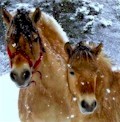


Pet Horses and Ponies
For information about horses, please click on the links below or the links at the top of the page.
Discoveries of man and horse drawings date back to 30,000 B.C. In 638 B.C., the first Olympic games with chariot races like modern day harness racing took place and later became popularized as the "The Sport of Kings." The oldest known breeds are the Arabian and Spanish horses, which later contributed to American breeds. New breeds are continuously being created, as breeders initiate breeding programs specifically designed to select horses to meet special needs. |
ADVERTISEMENT
|
|||||||||||||||||||||||||||||||||||||||||||||||||||
The horse (Equus caballus) is a large odd-toed ungulate mammal, one of ten modern species of the family Equidae. Horses have long been among the most economically important domesticated animals; however their importance has declined with the introduction of mechanization. The horse is a prominent figure in the ideals of religion, mythology, and art, as well as playing an important role in transportation, agriculture, and warfare. Most horses perform work such as carrying humans on their backs or are harnessed to pull objects
such as carts or plows. However, hundreds of distinct horse breeds were developed, allowing horses
to be specialized for certain tasks; lighter horses for racing or riding, heavier horses for farming
and other tasks requiring pulling power. Some horses, such as the miniature horse, can be kept as Because horses and humans have lived and worked together for thousands of years, an extensive specialized vocabulary has arisen to describe virtually every horse behavioral and anatomical characteristic with a high degree of precision. Depending on breed, management and environment, the domestic horse today has a life expectancy of 25 to 30 years. It is uncommon, but a few horses live into their 40s, and, occasionally, beyond. The oldest verifiable record was "Old Billy," a horse that lived in the 19th century to the age of 62. Regardless of a horse's actual birth date, for most competition purposes, horses are considered a year older on January 1 of each year in the northern hemisphere and August 1 in the southern hemisphere. The exception is endurance riding, where the minimum age to compete is based on the horse's actual calendar age. The following terminology is used to describe horses of various ages: The English-speaking world measures the height of horses in hands, abbreviated "h" or "hh", and is measured at the highest point of an animal's withers. One hand is 4 inches or 10.16 cm. Intermediate heights are defined by hands and inches rounded to the lower measurement in hands, followed by a decimal point and the number of additional inches between 1 and 3. Thus a horse described as 15.2 hh tall means it is 15 hands 2 inches (62 inches or 1.57 meters) in height. The size of horses varies by breed but can also be influenced by nutrition. The general rule for cutoff in height between what is considered a horse and a pony at maturity is 14.2 hand (58 inches or 147 cm) as measured at the withers. An animal 14.2 h or over is considered a horse and one less than 14.2 h is a pony.
The crucial importance of the feet and legs is summed up by the traditional adage, "no foot, no horse."
A horse’s sense of balance is outstanding, the cerebellum of their brain is highly developed, and they are very aware of terrain and placement of their feet. Horses’ sense of touch is better developed than many people think, they immediately notice when a fly or mosquito lands on them, even before the insect attempts to bite. Their sense of taste is well developed in order to determine the nature of the plants they are eating, and their prehensile lips can easily sort even the smallest grains. Horses will seldom eat most poisonous plants or spoiled food unless they have no other choice. All horses move naturally with four basic gaits: the walk, trot or jog, canter or lope, and gallop. Horses are prey animals with a well-developed fight-or-flight instinct. Their first response to threat is to startle and flee, although they are known to stand their ground and defend themselves or their offspring in cases where flight is not possible or when they young are threatened. They also tend to be curious. When startled, they will often hesitate and instant to ascertain the cause of their fright and may not always flee from something that they perceive as non-threatening. Through selective breeding, some horse breeds are quite docile, particularly certain large draft horses. However, most light riding breeds were developed for speed, agility, alertness, and endurance, natural qualities that extend from their wild ancestors. Horses are herd animals, with a clear hierarchy of rank, led by a dominant animal (usually a mare). Horses are also social creatures that are able to form companionship attachments to their own species and to other animals, including humans. They communicate in various ways, including vocalizations such as nickering or whinnying, mutual grooming, and body language. Many horses will become difficult to manage if they are isolated. When this behavior occurs while being handled by humans, the horse is called "herd bound". However, through proper training, it is possible to teach any horse to accept a human as a type of companion, and thus be comfortable away from other horses. Horses are mammals, and as such are all "warm blooded" creatures, as opposed to "cold blooded" creatures. However, these have developed a separate equine meaning to describe temperament, not body temperature. For example, the "hot bloods," such as racehorses, exhibit more sensitivity and energy, while the "cold bloods," such as most draft breeds are quieter, calmer creatures. Horses come in a wide range of heights, weights, and body types. Different breeds were developed with a specific "form" adapted to a particular "function" or type of work. For example, in terms of height, the largest members of some draft breeds can top 19 hands (76 inches or 2 meters), while the smallest miniature horse stands as 5.2 hands (22 inches or 0.56 meters), not significantly larger than a large dog. But height alone does not dictate function; a 17 hand Thoroughbred has a lean slime body type, weighing around 1,200 pounds with a "hot" temperament suitable for horse racing. In contrast, a 17 hand Shire has a heavy body, can weigh 2,000 pounds, has a very mild or "cold" temperament, and is suitable for farm work.
Competing theories exist as to the time and place of initial domestication. The earliest evidence for the domestication of the horse comes from Central Asia and dates to approximately 4,500 BC. Archaeological finds such as the Sintashta chariot burials provide unequivocal evidence that the horse was definitely domesticated by 2,000 BC.
Riders communicate with the horse through commands called aids. The main natural aids of the rider are the legs, the seat, the hands through the reins, and the voice. The rider's legs generally tell the horse to move forward or to turn. The hands help to guide the horse in the direction of the turn, and ask the horse to either slow his tempo or to slow from a faster gait to a slower one. The seat is the most difficult aid to develop, and can communicate to the horse not only to speed up, but also to turn and slow down. The voice is used less when mounted than when on the ground, but may be used to reinforce the hands, seat, and legs to speed up or slow down the horse. Correct position allows for the rider to communicate effectively without getting in the way of the horse. Though the position appears to be slightly modified according to the type of riding that is being performed, the fundamental need is to remain balanced over the horse at any given speed or discipline. Like most arts, riding takes years of practice to become competent as the riders work to refine their aids and position, and learn "feel" - the sense of what the horse is doing underneath them. From the time the horse was domesticated, a wide variety of riding methods or style have developed all of which balance the need to allow the horse freedom of movement in activities such as horse racing or show jumping and the need fro security and comfort for the rider, precision of commands, and overall control. Activities such as dressage and reining require high levels of control, while horse racing or show jumping require that a horse have considerable freedom of movement. Worldwide, the most common modern riding style is referred to in the United States as English riding, which is a broad style that encompasses most Olympic Equestrian competition and includes such specific style as dressage, hunt seat, show jumping, and saddle seat, among many others. Western riding is a popular style seen in North America, derived from the traditions of Spain, modified to fit the need of cattle ranchers. (source: wikipedia.org) more information from wikipedia.org
|
||||||||||||||||||||||||||||||||||||||||||||||||||||
|
|
||||||||||||||||||||||||||||||||||||||||||||||||||||
|
||||||||||||||||||||||||||||||||||||||||||||||||||||